
How to Start a Supermarket Business in India: Step-by-Step Guide
Connect Us
Recent Blog
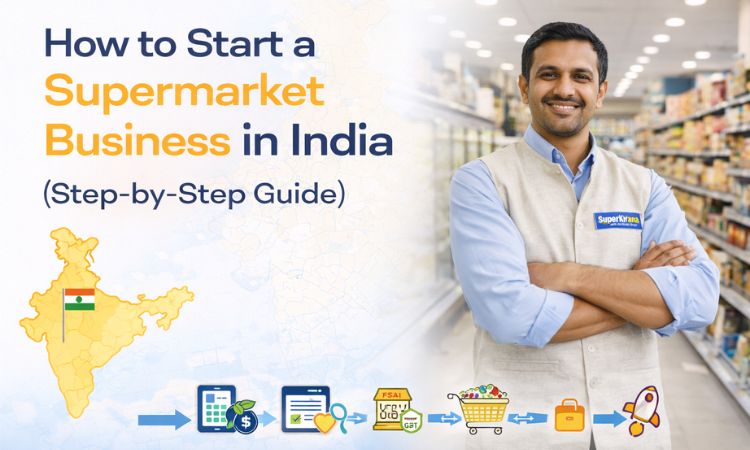
Starting a supermarket business in India is one of the most profitable retail opportunities in 2026. With more people shifting from traditional kirana shops to organized supermarkets, demand for modern grocery stores is growing rapidly across Tier 1, Tier 2, and Tier 3 cities.
Table of Contents
ToggleBut starting a supermarket is not just about renting a shop and filling shelves. A successful supermarket business in India requires the right location, investment, licenses, layout, suppliers, technology, and operational systems. Many new supermarket owners fail not because demand is low, but because they follow unstructured planning.
This guide will show you exactly how to start a supermarket business in India, step by step, including cost, licenses, layout, mistakes, trends, and why choosing the right supermarket franchise can significantly reduce your risk.
How to Start a Supermarket Business in India – Quick Overview
| Step | What You Must Do |
|---|---|
| 1 | Choose supermarket format (mini, medium, large) |
| 2 | Finalize store location |
| 3 | Select business model (independent or franchise) |
| 4 | Register business |
| 5 | Obtain FSSAI, GST & Shop Act licenses |
| 6 | Design store layout |
| 7 | Set up suppliers & inventory |
| 8 | Install POS & billing system |
| 9 | Hire and train staff |
| 10 | Launch & market the store |
How Much Does It Cost to Start a Supermarket in India?
The investment required to start a supermarket business in India depends on store size, location, interiors, and inventory.
| Store Type | Area | Approx Investment |
|---|---|---|
| Mini Supermarket | 400–700 sq ft | ₹10–15 Lakhs |
| Medium Supermarket | 800–1500 sq ft | ₹18–30 Lakhs |
| Large Supermarket | 2000+ sq ft | ₹35 Lakhs+ |
This includes interiors, racks, billing software, inventory, licenses, branding, and initial working capital.
To see a full breakdown of setup cost, interiors, inventory, and monthly expenses, explore our 2026 supermarket startup cost guide.
1. Analyze Market Trends for 2026:
Before you invest, study all the retail trends for 2026. As per a report, the Indian market is set to $1.6 trillion by 2030 with the help of urban growth, rising incomes, and digital rise. Supermarkets are not just shopping malls anymore. They are turning into lifestyle centres.
Customers today want:
- Contactless checkout
- Home deliveries
- Health-focused products
For these, brands are using new tech, digital payment, and data analysis tools. Here are some more trends you must know about:
- Urban demand for organised retail is rising.
- Quick commerce and hybrid stores are trending.
- Customers want fast deliveries.
- Supermarkets are innovating new ideas to compete with e-commerce giants.
Also Read: Documents Required to Start a Supermarket Franchise
2. Prepare a Solid Business Plan
A business plan is a map that guides you through your business journey. For stage-0, your business plan should include market research, SWOT analysis, product selection, pricing, and marketing plans. The very first detail you must know is who to serve, at what price. Remember, calculation makes profits, capital requirement, and potential risks.
Here is what to do?
- List your supermarket budget. Consider rent, décor, staff, technology, and initial stocks.
- Plan your finances, such as savings, loans, and investments.
- Your business plan should also include expected monthly sales, operating costs, and profit margins to calculate break-even time.
3. Choose Your Business Model
There are multiple supermarket models- independent stores, franchises, or partnerships. Each has pros and cons, and you must choose the one with the most suitable features to your goals.
Here is what to do?
- List your supermarket budget. Consider rent, décor, staff, technology, and initial stocks.
- Plan your finances, such as savings, loans, and investors.
- Choosing the right supermarket business model is one of the biggest success factors in the Indian retail market.
If you are confused between FOFO, FOCO, COCO, or hybrid models, read our complete guide to supermarket franchise models to choose the right format for your investment.
4. Select the Right Location
One of the biggest mistakes new supermarket owners make is not choosing the right location at all. Your business is dependent on the traffic, and it depends on the right location. Choose an area with high footfall, such as a residential area, near schools, or IT parks.
Location plays a major role in the success of any supermarket business in India, especially for footfall and repeat customers.
| Business Model | Description | Benefit | Drawback |
|---|---|---|---|
| Independent Store | Full control, create own brand | Flexibility, unique identity | High risk, no support network |
| Franchise | Use established brand, SOPs | Low risk, support, faster break-even | Franchise fee, less autonomy |
| Partnership | Shared capital and responsibilities | Less financial burden, new contacts | Risk of disputes, shared profits |
But here’s more to it:
- Analyse local competition
- Choose spaces with comfortable shelving, movement, and parking.
- Check zoning laws.
- Choose good signage and street-facing shops.
5. Complete Legal Formalities
Fulfill all your legal formalities first. Register your business and get all the licenses. Here’s the list:
- GST Registration
- FSSAI license for food safety
- Shop Act license for labor laws and working hours
- Trade license,
- fire safety NOC, and
- Establishment Act registration
These licenses are mandatory to legally operate a grocery store or supermarket in India.
Starting a supermarket franchise requires multiple registrations and approvals. You can check the complete list of licenses required to start a supermarket franchise in India in our detailed guide.
6. Plan Your Store Layout and Design
First impressions matter. People have evolved, and instead of some boring shopping complex, they want clear signage, easy walkways, clean shelving, attractive product displays, and interactive layouts.
What to do then?
- Group similar products
- Provide enough lighting
- Leave space for customers to move comfortably.
- Set up checkout counters for smooth billing.
- Maintain hygiene and use attractive visual merchandising.
A well-planned supermarket layout increases customer movement, impulse buying, and overall store profitability.
7. Build Relationships with Suppliers
Businesses run on relationships. Choose reputable suppliers who offer quality products at good pricing. Next, maintain a good relationship with them for all future deals.
Here is what to do throughout the process:
- Compare rates, delivery timelines, and credit terms.
- Build variety; offer groceries, household items, personal care, etc.
- Keep in touch with multiple suppliers.
- Group similar products
- Provide enough lighting
- Leave space for customers to move comfortably.
- Set up checkout counters for smooth billing.
- Maintain hygiene and use attractive visual merchandising.
8. Hire and Train Staff
Running a supermarket is not a one-man job. You need people to help with stocking, billing, cleaning, and customer support.
Here’s what to do:
- Hire enough people.
- Train them in POS operations, customer service, hygiene, and inventory handling.
- Give your staff uniforms and ID cards.
- Focus on clear communication.
- Create a quick problem-solving environment
Well-trained staff directly impact customer satisfaction and store reputation.
Also Read: Top Challenges Faced by Supermarket Businesses in India
9. Set Up Technology and Software
Modern supermarkets need robust billing software and an inventory management system. You need cloud-based POS systems, digital accounting, inventory management software, and analytics.
Here’s what to focus on:
- Use barcode scanners
- Digital payment gateways
- Run loyalty programs to speed up operations.
- Use data to select top products and slow sellers.
- Integrate with e-commerce for home deliveries.
Technology is essential for running a modern supermarket or grocery store business in India.
10. Marketing and Launch Strategy
Next, plan your launch. You need customers on day 1, and this will happen only when people know about you before the launch itself.
Here’s what to do:
- Plan promotions and discounts.
- Use digital platforms to advertise.
- Offer free samples, loyalty cards, and festive offers [if any]
- Register on Google My Business and a digital platform for online sales.
- Build a website and engage customers through WhatsApp marketing.
A strong launch helps a new supermarket gain traction faster.
11. Track Inventory and Manage Finances
Never forget to check your stock levels daily. Avoid over-stocking or over-ordering.
Here’s what to do:
- Use the expiry date management system.
- Keep a daily record of expenses and profits.
- Set the recorder for popular items.
- Review sales trends monthly.
12. Innovate and Adapt Continuously
The Indian retail industry is taking a sharp turn. Today, you must adopt new strategies such as:
- In-store events
- Digital payments
- Quick commerce,
- Health product aisles
Also, stay open to customer feedback and adapt pricing accordingly. But here’s more:
- Stay alert for new trends such as micro-fulfilment.
- Explore home delivery tie-ups and digital loyalty programs.
Advantages of Starting a Supermarket Business:
Owning a supermarket business has high benefits in 2026. But here are some benefits people miss:
- 1. Bulk buying means more profit margin on every product.
- 2. A wide range of products attracts all types of customers and stabilizes everyday sales.
- 3. Supermarkets have fixed pricing and no-credit policies. This saves time and reduces losses.
- 4. Supermarkets generate local jobs and support local people.
- 5. Supermarkets change with the seasons and draw customers all the time.
- 6. Visibility and branding boost supermarket recognition.
Mistakes to Avoid When Opening a Supermarket
Learning from others’ errors increases your chance of success: Ignoring market research leads to failure. Always research the right location, products, competition, and trends.
- Not planning for capital needs and first-year expenses.
- Poor inventory management results in losses.
- Neglecting customer experience and feedback.
- Not training your staff for sales and customer service.
- Skipping on legal compliance.
- Expanding too fast without stable profits and operational disciplines.
- Not using technology.
- Failing to utilise new trends.
Why Should You Choose a Supermarket Franchise?
Launching a supermarket independently requires high capital, deep business knowledge, supplier connections, and years of trial-and-error. A supermarket franchise model helps you skip these risks and start strong from day one. Here’s why a franchise is a smarter choice:
- Lower Risk, Higher Success Rate: Franchise models come with proven systems, trained teams, and predictable revenue patterns, reducing your learning curve.
- Established Brand Reputation: Customers trust familiar brands. A franchise instantly gives your store visibility, credibility, and faster footfall.
- Reduced Operational Costs: You avoid unnecessary spending on branding, trial marketing, unplanned inventory, and vendor errors
- Bulk Purchasing Power: You get products at better margins thanks to centralized purchasing and long-term supplier partnerships.
- End-to-End Business Support: You receive guidance in operations, marketing, store setup, technology, training, and compliance, something that standalone stores usually lack.
- Ready Marketing & Advertising System: You don’t have to create campaigns from scratch. The brand drives marketing while you focus on running the store.
Why SuperKirana Is a Safer Way to Start a Supermarket Business in India
SuperKirana is one of India’s fastest-growing supermarket franchise networks, built for Tier 2 & Tier 3 success. As a leading supermarket franchise in India, SuperKirana has become the trusted choice for thousands of kirana and supermarket owners who want a profitable, modern, and fully supported business model.
1. Strong Brand Presence in Tier 2 & Tier 3 Cities
SuperKirana is designed for India’s small-town retail consumers, where supermarket demand is rising rapidly.
2. Low Investment & Quick Setup (30-Day Store Launch)
You get a structured, cost-efficient model that helps you open your store in just 30 days with full company support.
3. Proven Business Model With Faster ROI
SuperKirana follows a predictable revenue system, helping new owners achieve faster breakeven and healthy profit margins.
4. Complete Store Setup Support
From store design to branding, billing systems, inventory planning, and visual merchandising—everything is handled by experts.
5. Inventory & Supply Chain Support
Access to large distributors, fast-moving products, and bulk rate benefits—ensuring better profits and fewer stock issues.
6. Staff Hiring & Training
The company provides staff onboarding, POS training, customer handling training, and operational SOPs.
7. Marketing & Digital Growth Support
SuperKirana provides:
Social media promotions
- Launch marketing
- Store branding
- Loyalty programs
- Digital tools for customer engagement
8. Regular Discounts & Festive Offers
Centralized offers, seasonal discounts, and promotional schemes help increase footfall without extra effort from the franchisee.
9. Technology-Driven Retail Model
Every store gets access to:
- POS software
- Inventory management tools
- Digital payment systems
- Analytical dashboards
Final Thoughts:
Starting a supermarket in India is a smart move in 2026. Why? Because retail marketing is expanding, and supermarkets are at the centre of this change. Rising urban growth is attracting customers to organised shopping, and this fuels rapid supermarket growth.
But before you launch a supermarket business, you must do careful planning, follow a customer-focused approach, and use digital tools. Moreover, avoid the common pitfalls discussed in this blog. And if you want a simpler, low-risk entry into modern retail, exploring grocery franchise opportunities can give you a faster, more profitable start. With the right steps, tools, and vision, your supermarket business can generate solid profits and grow into a successful retail brand.
FAQs:
- 1. What is the investment required to open a SuperKirana supermarket franchise?
The investment for a SuperKirana franchise depends on the store size, location, interiors, and inventory. On average, the cost starts from ₹10–15 Lakhs for compact formats and can go higher for larger supermarkets. Our team helps you choose the best plan based on your area, budget, and customer demand.
- 2. Can I convert my existing kirana store into a SuperKirana supermarket?
Yes! Most SuperKirana stores are upgraded versions of traditional kirana shops. We provide store design, branding, inventory setup, digital billing, and a complete upgrade plan to transform your shop into a modern, high-profit supermarket.
- 3. What support will SuperKirana provide to franchise owners?
SuperKirana offers end-to-end support, including:
- Store setup & interiors
- Inventory & supplier onboarding
- Digital billing & POS systems
- Staff training
- Branding & marketing support
- 24/7 backend assistance
- Launch planning and ongoing operational guidance
Everything you need to run a successful supermarket is provided by the core team.
- 4. How much space do I need to open a SuperKirana store?
A minimum of 400–600 sq. ft. is suitable for a compact model, while 1000+ sq. ft. works perfectly for a full supermarket layout. Our team helps you assess the space and plan shelves, walkways, and product placements for maximum sales.
- 4. How much space do I need to open a SuperKirana store?
A minimum of 400–600 sq. ft. is suitable for a compact model, while 1000+ sq. ft. works perfectly for a full supermarket layout. Our team helps you assess the space and plan shelves, walkways, and product placements for maximum sales.
- 5. What are the main benefits of choosing the SuperKirana franchise?
With SuperKirana, you benefit from:
- A fast-growing supermarket franchise in India
- Proven business model
- Strong supply chain network
- Access to 20,000+ products and leading brands
- Digital tools & automated billing
- Low investment & high profit potential
- Quick store launch in 30 days
We help franchise partners grow with speed, support, and clear business strategies.
- 6. Do I need retail experience to start a SuperKirana supermarket?
No, you don’t need prior retail experience. SuperKirana offers complete training on billing, customer service, inventory, merchandising, and store operations, so even first-time entrepreneurs can successfully run the store.
- 7. How long does it take to open a SuperKirana store?
From approval to launch, the entire process usually takes 30 to 45 days, depending on the location, store size, and branding work. Our team ensures a smooth and timely store setup.
- 8. Will SuperKirana help with inventory and supply chain?
Yes. SuperKirana provides a centralized supply chain system ensuring timely restocking, access to top brands, better pricing, and efficient inventory management. This helps reduce wastage and maximize profits.
- 9. What licenses do I need to open a SuperKirana supermarket?
You need the following licenses:
- GST Registration
- Shop & Establishment License
- FSSAI License
- Trade License
- Basic ID & Address Proof
Our team guides you through all legal steps and paperwork.
- 10. Is a supermarket franchise profitable in India?
Yes. With rising urban demand, organized retail, and repeat buying patterns, supermarket franchises offer strong profit margins. SuperKirana’s optimized pricing, supply chain, and digital tools further improve revenue and speed up break-even.
Also Read: Top Supermarket Franchise in India