
Top Challenges Faced by Supermarket Businesses in India (And Smart Ways to Overcome Them)
Connect Us
Recent Blog
When it comes to running a supermarket in India, it may look like a stable and profitable business on the surface. However, the reality is far more complicated. Everything from handling thousands of products to dealing with staff, suppliers, customers, and regulations, supermarket owners face daily operational pressure. Several stores struggle not just because demand is low, but due to systems are weak or sometimes decisions being unstructured.
Table of Contents
ToggleIn this guide, we’ll explore the most common challenges faced by supermarket businesses in India. Furthermore, you can get practical and proven solutions that truly help store owners build sustainable, long-term operations, especially in Tier 2 and Tier 3 cities.
Before diving into individual challenges, it’s essential to understand one core truth.
Most supermarket problems are not isolated issues, they are connected.
Poor inventory control negatively impacts cash flow. Weak pricing affects customer retention. Staffing issues impact service quality. That’s exactly why supermarkets need structure, not just hard work.
The Core Reality: Why Supermarket Businesses Struggle
Supermarket owners mostly start with good intentions and local trust, but some of them underestimate the complexity of modern retail. A supermarket is not just a bigger kirana store; it’s actually a system-driven business that really needs planning, data, and discipline.
Without the right processes, even high footfall can’t guarantee profitability. Let’s now explore the 8 biggest challenges supermarket businesses face, and exactly how to solve them smartly.
If you’re still in the planning stage, our step-by-step guide on how to start a supermarket business in India can help you understand the process from setup to launch.
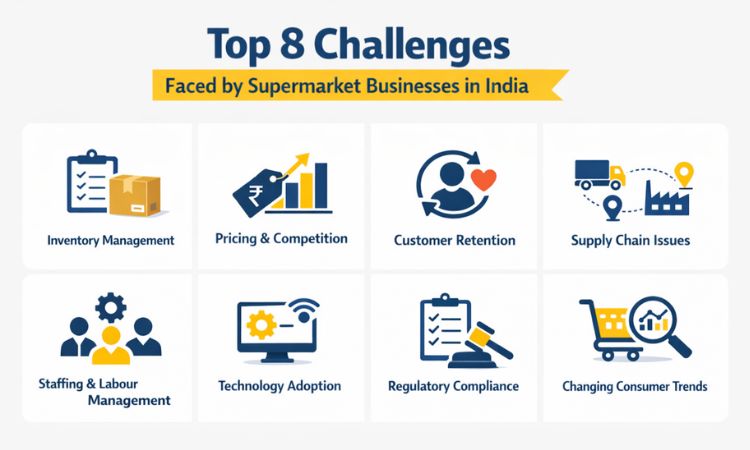
Top 8 Common Challenges Faced by Supermarket Businesses in India
1. Inventory Management Challenges
Inventory is the backbone of any supermarket, but it is also the biggest source of losses when managed poorly. Overstocking ties up working capital and increases expiry risk, while understocking leads to lost sales and frustrated customers. Managing thousands of SKUs manually becomes extremely difficult as the store grows.
Perishable goods add another layer of complexity. Expiry losses in dairy, bakery, and packaged food items silently eat into margins if stock movement is not tracked properly.
Solution:
Supermarkets need data-driven inventory systems that track stock movement, expiry dates, and demand patterns. Regular stock audits combined with demand forecasting help owners order smarter, not more. Centralised inventory planning and fast-moving SKU prioritisation significantly reduce wastage and improve cash flow.
2. Pricing Pressure and Intense Competition
Supermarkets today compete not only with nearby stores but also with large retail chains and online grocery platforms. Customers are price-aware and quick to switch if they feel better value exists elsewhere. However, aggressive discounting often reduces profitability instead of improving it.
Maintaining competitive prices while covering operational costs becomes a daily balancing act.
Solution:
Instead of competing only on price, supermarkets should focus on pricing discipline and category-level margin planning. Centralised procurement, bulk purchasing, and exclusive product tie-ups help improve margins. Loyalty-based pricing, bundled offers, and selective discounts are far more effective than across-the-board price cuts.
3. Customer Retention and Loyalty Issues
Attracting customers is easier than retaining them. Many supermarkets see high churn because customers don’t feel any emotional or experiential connection with the store. Poor layout, slow billing, indifferent staff behaviour, or inconsistent product availability quickly push customers elsewhere.
Customer loyalty cannot be forced; it must be earned.
Solution:
Improving the overall shopping experience is key. Clear store layout, clean aisles, trained staff, and predictable pricing build trust. Simple loyalty programs, personalised offers, and consistent service encourage repeat visits. Supermarkets that position themselves as part of the local community naturally retain customers better.
Also Read: Documents Required to Start a Supermarket Franchise Business in India
4. Supply Chain Disruptions
Supply chain issues are one of the most stressful challenges for supermarket owners. Delayed deliveries, stockouts of fast-moving items, dependency on a limited number of suppliers, and inconsistent pricing disrupt daily operations and customer trust.
Unexpected disruptions, such as regional issues, transport delays, or vendor shortages, can severely impact availability.
Solution:
A diversified supply chain is essential. Supermarkets should avoid dependency on a single distributor and build relationships with multiple vendors, including local suppliers. Centralized warehouses, scheduled replenishment cycles, and supply chain visibility tools help ensure consistent stock availability and smoother operations.
5. Staffing and Labour Management Problems
High staff turnover, untrained employees, and rising labour costs are common in supermarket businesses. Poorly trained staff slow down operations, affect customer experience, and increase errors at the billing and inventory handling stages.
Balancing staff costs while maintaining service quality is a constant challenge.
Solution:
Clear roles, standard operating procedures (SOPs), and structured training programs improve staff efficiency. Smart scheduling prevents overstaffing during low-traffic hours and understaffing during peak times. Performance-based incentives and growth opportunities help retain reliable employees.
6. Technology Adoption and Integration
Technology can either simplify supermarket operations, or complicate them if implemented incorrectly. Many store owners struggle to adopt POS systems, inventory software, or digital reporting due to lack of training or fear of disruption.
Manual processes limit scalability and increase errors, but rushed tech adoption can create confusion.
Solution:
Supermarkets should adopt simple, integrated technology systems that combine billing, inventory, and reporting. Training staff before implementation is crucial. Technology should support daily operations, not slow them down. When used correctly, tech improves decision-making, reduces losses, and saves time.
7. Regulatory and Compliance Challenges
Supermarkets operate under multiple regulations, including FSSAI, GST, the Shop & Establishment Act, labour laws, and local municipal rules. Keeping up with changing compliance requirements can be confusing and time-consuming.
Non-compliance leads to penalties, inspections, and operational disruptions.
Solution:
A structured compliance approach is essential. Maintaining proper documentation, conducting regular audits, and staying informed about regulatory updates help avoid legal trouble. Clear compliance checklists and timelines simplify the process and reduce stress for store owners.
For a detailed breakdown of approvals, registrations, and compliance, refer to our guide on legal requirements for startinga supermarket franchise in India.
8. Adapting to Market Trends and Changing Consumer Behavior
Consumer expectations are evolving rapidly. Today’s customers expect clean stores, organized shelves, digital payments, better product variety, and consistent availability. Supermarkets that fail to adapt risk becoming irrelevant.
Ignoring market trends leads to stagnant growth.
Solution:
Regular market research, customer feedback, and sales data analysis help supermarkets stay aligned with consumer needs. Expanding product categories, introducing new brands, and improving store aesthetics keep the business competitive. Supermarkets that evolve with customer behavior remain future-ready.
How Structured Systems Reduce These Challenges
Most supermarket challenges stem from lack of structure, not a lack of effort. Businesses that rely only on manual decisions struggle to scale. Structured systems, covering inventory, supply chain, pricing, staffing, and compliance, reduce risk and improve consistency.
This is where ecosystem-driven models outperform standalone stores.
Choosing the right operating structure is equally important, which is why understanding supermarket franchise models like FOFO, FOCO, COCO, and Hybrid plays a key role in long-term success.
How SuperKirana Helps Supermarket Owners Overcome These Challenges
SuperKirana supports supermarket owners by addressing the most common operational challenges through a structured, system-driven franchise model. Instead of leaving store owners to manage everything independently, SuperKirana provides centralized processes, expert guidance, and ongoing operational support to reduce risk and improve efficiency.
From inventory planning and supply chain coordination to technology integration and staff training, SuperKirana helps supermarket owners operate with clarity and control. Centralized procurement ensures better pricing consistency and product availability, while integrated POS and inventory systems help track stock movement, sales performance, and expiry risks more accurately. Key factors that position SuperKirana among the best supermarket franchise in India for sustainable growth.
SuperKirana also assists franchise partners with regulatory compliance, documentation, and store setup, helping them avoid common legal and operational mistakes. With a strong focus on Tier 2 and Tier 3 cities, the model is designed to support local entrepreneurs with practical systems that work on the ground, enabling them to build supermarkets that are efficient, compliant, and scalable over the long term.

Conclusion
Owning a supermarket gives long-term stability, but success depends on how perfectly challenges are managed. Inventory control, pricing discipline, customer retention, staffing, technology, and compliance all really play crucial roles.
All supermarkets that understand these challenges early and adopt structured solutions are far more likely to grow profitably and sustainably. With the right planning, systems, and support, supermarket businesses can stand out in India’s evolving retail landscape.
Along with operational challenges, understanding the cost to open a supermarket or grocery store in India is essential for realistic planning and long-term sustainability.
Also Read: Top Supermarket Franchises in India