
How to Design a Supermarket Layout for Higher Sales in India?
Connect Us
Recent Blog

A proper supermarket design can uplift your sales, consumer engagement, and chances of repeat visits. But how does this happen? And more importantly, what exactly is supermarket layout design?
Table of Contents
ToggleSupermarket layout goes way beyond shelves or making the store look attractive. As Steve Jobs once said, “Design is that work.” Supermarket design layout, when done thoughtfully and well-planned, pushes the customer movement, impulse buying, average bill value, and repeat visits.
Many supermarkets struggle not because products are missing but because customers didn’t feel the store was functional or found the store confusing to shop in. Whether you’re planning to start a supermarket, convert a Kirana store, or improve an existing grocery store, it’s important to know the basics of supermarket layout and how smart supermarket layout design can increase sales. This is especially true in Tier 2 and Tier 3 cities.
If you’re planning to start or expand a store, understanding layout is as important as knowing the full process of starting a supermarket business in India.
What Makes a Supermarket Layout Successful in India?
A successful supermarket layout is one that feels easy, familiar, and convenient for customers. It’s not about design alone, but making the supermarket functional for customers. Now, talking about Indian shopping habits, shoppers often prefer quick navigation, clear visibility of products, and fast billing. Unlike malls or premium retail stores, supermarkets must balance function over decoration.
Here’s what to note:
A supermarket is not just a big Kirana Store. It operates on a fixed system where layout planning, product placement, and customer flow work together to improve sales up to 15%.
Now, the question is how to improve supermarket layout.
Layout planning also depends on the supermarket franchise models you choose, as space usage and control vary across formats.
Key Strategies for Designing a Profitable Supermarket Layout:
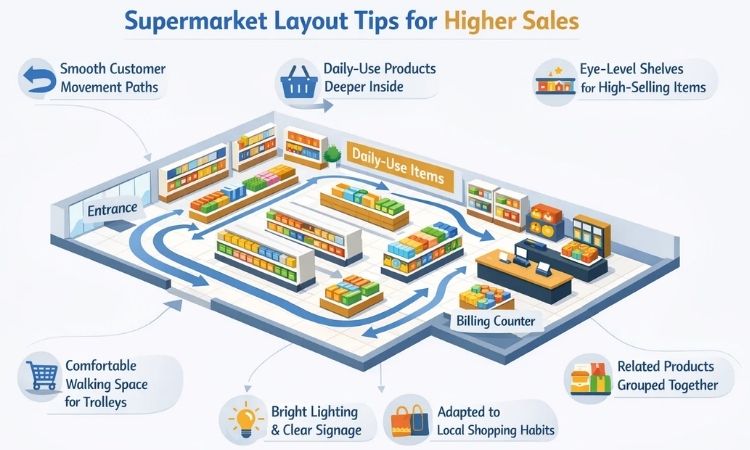
1. Make It Easy for Customers to Move Around the Store
A supermarket should always feel natural and effortless for customers. Why? Because it lets them move freely and they can see products as much as they want. Results? They spend more time inside the store, exploring, and make better buying decisions, often resulting in more sales figures.
Your store movement should guide the customers through a logical flow rather than random paths. The paths should lead them to multiple categories without making them feel bored.
Good movement planning includes:
- Clear entry and exit points
- Straight, visible store paths
- No dead ends or blocked sections
- Easy access to billing counter
2. Place Daily-Use Products Where Customers Naturally Walk
Daily-use products are the main reason customers visit a supermarket. Use them to bring customers slightly inside the store. This way, customers walk past other sections, getting exposed to other products as well. Results? Higher overall sales.
Best practices for daily-use product placement:
- Avoid placing essentials right at the entrance
- Keep high-demand items spread across the store
- Use clear category signage to guide customers
3. Keep High-Selling Products at Eye Level
Shelf positioning is a key factor in supermarkets. Customers first notice items that are placed at eye-level and pick it more frequently. Keeping your high selling products at eye level means more sales incoming.
This is one of the simplest supermarket layout techniques, improving sales without extra investment. So what to do?
- Keep high selling and high margin products at eye level where customers can see them easily.
- Less important or bulky items should be placed on lower or higher shelves.
Smart shelf planning tips:
- Eye-level shelves for fast-moving items
- Lower shelves for bulk or heavy products
- Upper shelves for slow-moving stock
Also Read: Top Supermarket Franchises in India
4. Use Billing Counters to Increase Last-Minute Purchases
Billing counters are powerful impulse-buying zones. This section pushes people to make quick purchases, especially for low-cost items. A well-designed billing area can increase the average bill value without affecting customer experience.
Here are the Products that work best near billing counters:
- Chocolates and snacks
- Batteries and small electronics
- Tissues and personal care items
- Small daily-use products
5. Keep Store Walking Space Comfortable for Browsing
Comfortable store walking space plays a key role in how long customers stay inside the supermarket. Crowded paths make shoppers uncomfortable and rush their decisions, while well-balanced space encourages relaxed browsing.
Indian supermarkets must plan walking space carefully to support baskets, trolleys, and peak-hour footfall without wasting display area.
Walking space planning should consider:
- Easy movement for two customers at once
- Space for baskets and trolleys
- Smooth access to popular sections
6. Keep the Store Clean, Bright, and Easy to Understand
Supermarket interior design should prioritise visibility and clarity over decoration. The best option for it is to use lights. Lighting makes products more attractive and gives your customers more confidence in freshness and hygiene.
Use clean signage to help customers find products quickly. This reduces confusion and improves the shopping experience.
Focus areas for interior design:
- Bright and uniform lighting
- Clearly marked product categories
- Neat and organised shelves
- Clean floors and counters
7. Place Related Products Together to Increase Sales
One hack that supermarkets often miss is keeping the related products together. This makes shopping easier and increases cross-selling opportunities. Results? Customers love it when it’s easy for them to find all the products together. This makes them buy additional products.
This strategy works well for Indian shopping habits because customers here look for quick and complete purchases.
Here are some examples of effective product grouping:
- Atta with ghee or oil
- Pasta with sauces
- Cleaning liquids with scrubbers
8. Design the Store Around Local Shopping Habits
Every supermarket has a unique customer base. For example, stores in Tier 2 and Tier 3 cities usually see customers buying daily essentials, value-packs, and local brands. So, you must consider the layout around the local preferences. This improves local relevance and repeat visits.
But there’s more. Understanding the local buying patterns helps you decide what to keep more in your supermarket and what to reduce.
Here’s how to do so:
- Prioritising fast-moving local brands
- Adjusting shelf space based on demand
- Simplifying layout for quicker shopping
Layout decisions also impact the overall cost to open a supermarket or grocery store, especially shelving, lighting, and space utilisation.
What Are Common Supermarket Layout Mistakes to Avoid?
Some of the most common layout mistakes are easily solved with smart planning. Here are what most supermarkets miss:
- Stocking too many items may make your displays a mess and may hide products.
- Dim or uneven lights reduce product appeal and reduce impulse buying.
- Tight spaces often block the movement and irritate customers.
- Random product placement creates confusion and prevents forgetting items.
- Dead-end areas disrupt flow and create awkward navigation.
- Unclear signs increase time and customer stress.
- Ignoring the customer paths fails to guide traffic and misses sales opportunities.
- Unclear billing areas cause delays and congestion.
- Outdated setups and shelves may not appeal to customers and new products.
- Cluttered aisles block traffic and push buyers away.
Apart from layout mistakes, ignoring licenses and legal requirements can also delay store launch and affect operations.
How SuperKirana Helps Design High-Performing Supermarket Layouts?
SuperKirana helps supermarket owners shape their layout and design that are practical, sales-focused, and suitable to Indian buying habits. Now, what does it mean? Instead of decoration or copy designs, we focus on functional store planning. This improves the overall product visibility, customer movement, and operation efficiency. These are the key factors that run a successful supermarket franchise in India.
SuperKirana optimises your space, product zoning, and lighting and offers a complete layout planning for Kirana-to-Supermarket conversion. We follow a structured, system-driven approach that helps our team design the layout smartly. We focus on:
- Store Size
- Local Demand
- Category performance
- Customer Flow, etc.
We use every square foot of the store effectively.
SuperKirana also supports franchise partners with our standard layout guidelines, shelf planning, and category and checkout area optimization. This helps reduce the most common issues, like congestion, poor visibility, and poor billing zones. Our integrated planning helps improve the inventory movement, replenishment, and customer experience altogether.
But here’s more: We strongly focus on Tier 2 and Tier 3 cities, which means our strategy suits supermarkets with limited space and where people buy differently than urban areas. We understand that customers at such locations prefer a quick shopping experience. So, we combine practical design principles with our proven retail systems. By following this, SuperKirana empowers the entrepreneurs to build efficient and scalable supermarkets in India’s growing retail market.
Conclusion: A Smart Layout Is a Sales Tool, Not Decoration
Supermarket layout is not just for design but function. A good layout contributes to customer satisfaction, eases their shopping, and makes them revisit. Results? More loyal customers, more sales, and a significant increase in happy customers.
Unlike what most people assume, layout is not limited to decoration. It includes product placement and walking space to lighting and checkout planning. These are small, minute layout details that create a big impact. Now, why is this important? Supermarkets with proper layout design are more likely to grow in the highly competitive Indian market.
Also Read: Top Challenges Faced by Supermarket Businesses in India