
Start Your SuperKirana Journey
Contact us for a free consultation:
Opening a supermarket or grocery store in India in 2025 is an exciting opportunity, but it’s also a serious financial decision. Rising demand for organized retail, changing shopping habits, and the popularity of modern grocery marts have made this business more attractive than ever.
At the same time, costs like rent, inventory, infrastructure, and technology mean you cannot jump into it blindly.
If you’re thinking about starting a supermarket, you probably have many questions:
How much investment is needed?
Where does most of the money go?
Is a supermarket franchise in India better than starting alone?
This blog will guide you step by step through the cost to open a supermarket, major expense heads, profit potential, cost-cutting strategies, and how a franchise like SuperKirana can make your journey easier and safer.
Before we discuss cost, it’s important to understand the franchise model.
A supermarket franchise is a business model where an entrepreneur (franchisee) operates a store using the brand name, systems, and support of an established company (franchisor). Instead of building everything from scratch, you get:
A ready brand identity
Store setup guidelines
Supplier and inventory support
Billing and technology systems
Staff training and operational SOPs
Marketing and promotion support
In simple words, you’re not experimenting alone, you’re following a proven system that has already worked in multiple locations. For many new entrepreneurs, this is safer than launching an independent store with no guidance.
The cost to open a supermarket in India depends on several key factors:
On average, the investment can range from ₹10 lakhs to ₹2 crores:
The exact cost will only be clear after you decide where you’ll open, what size store you want, and what kind of customer experience you plan to offer.
To make this clearer, let’s look at the major cost components one by one.
Also Read: How to start a supermarket business in India guide?
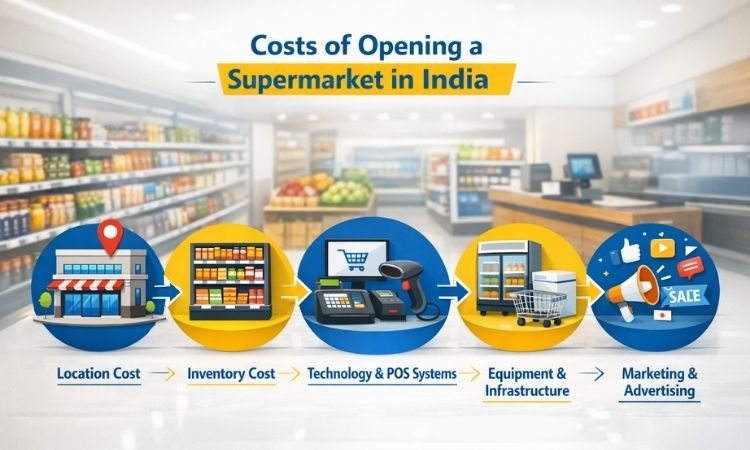
Location is often your first and biggest decision, and one of the most expensive.
You can either rent a commercial space or purchase one:
Good supermarket locations include:
A poor location may give you lower rent but will also give you lower footfall. A good location might be more expensive, but it supports long-term sales and brand growth. So, think of location as both a cost and an investment.
Your supermarket is only as good as its shelves.
Inventory includes:
Inventory cost depends on:
Store size – small stores may start with a few lakhs of stock; larger supermarkets need much more.
Product range- more categories + more brands = higher inventory cost.
Inventory cost can range from a few lakhs to tens of lakhs, and for very large stores, even higher. You also need working capital to keep restocking as items sell.
Modern supermarkets are not just about racks and shelves, they’re powered by technology.
Key tech components include:
Some advanced supermarkets also use:
These systems may look like extra cost initially, but they reduce manual errors, save time, and improve customer experience, ultimately protecting your profit.
Beyond inventory and tech, you’ll also spend on physical equipment such as:
The cost will vary depending on the size of your store and the quality of equipment you choose. Cheaper equipment might save you money now but could lead to higher electricity bills or maintenance in the future, so choose wisely.
Even the best supermarket needs customers who know it exists.
Your marketing budget may include:
Marketing is not a one-time cost; you must keep allocating some amount for regular promotions, especially around festivals and special events. Done right, it helps you build a loyal customer base.
Yes, opening a supermarket can be very profitable, but it is not automatic.
Profitability depends on:
In general, supermarkets operate on moderate margins (often 10–18%) but benefit from high volume and repeat purchases. Groceries are daily-need products, which means customers keep coming back. If you manage your costs well and provide a good experience, a supermarket can become a stable, long-term income source.
Despite the initial cost, a supermarket business has several unique advantages:
In a supermarket, customers pick items directly from the shelves. This saves time, reduces dependence on counter staff, and encourages impulse buying. Compared to a traditional kirana store where customers must ask for every item, self-service feels more modern and satisfying.
Supermarkets usually follow a fixed price policy with clear tags, occasional discounts, and offers. There is no daily bargaining over rates. This makes billing faster, reduces confusion, and protects your profit margins.
Well-organized shelves allow customers to see, compare, and choose products easily. Attractive displays, category signage, and logical product grouping improve the shopping experience and encourage customers to buy more.
Unlike local kirana shops, which often give goods on credit, most supermarkets follow a no-credit or minimal-credit policy. Customers pay immediately through cash, UPI, card, or wallet, which keeps your cash flow strong and reduces the risk of bad debts.
These advantages make supermarkets a more scalable and system-driven business compared to traditional unorganized retail.
The cost to open a supermarket may look high, but there are smart ways to control it.
Many suppliers offer better rates or discounts on bulk orders. You can also join small business associations or local trade groups that provide special pricing, offers, or support services at lower costs.
Using electronic price tags, barcode-based billing, and automated reports reduces manual errors and minimizes the need for extra staff. While there is an upfront tech cost, your annual savings in labour and mistakes can be significant.
Don’t accept the first rent number you hear. Negotiate for:
Even a small reduction in rent or deposit can make a big difference in your initial cash flow.
Energy-efficient refrigerators, LED lighting, and optimized cooling can reduce electricity bills month after month. This directly improves profitability in the long run.
If you are short on budget, you can sometimes save on delivery or logistics charges by picking up goods directly from the supplier or wholesale market, at least in the early stages.
These strategies help you lower the supermarket setup cost while keeping the store functional and customer-friendly.
Starting a supermarket from scratch means you are responsible for everything, location planning, layout, branding, vendor tie-ups, technology, staff training, and marketing. For someone new to retail, this can be overwhelming and risky.
This is where SuperKirana offers a better and safer path.
SuperKirana is one of India’s fastest-growing supermarket franchise in India networks, especially focused on Tier 2 and Tier 3 regions. With 120+ stores and 1,200+ brand collaborations, it provides a complete ecosystem for entrepreneurs who want to open a grocery mart or supermarket without guessing their way through.
With SuperKirana, you get:
Instead of spending lakhs on trial and error, you follow a proven supermarket franchise model in India, designed for faster growth and better profitability. For many entrepreneurs, especially those upgrading from a traditional kirana store, SuperKirana provides a ready platform to enter modern retail with lower risk.
Understanding the cost to open a supermarket or grocery store is the first step towards making a confident decision. The total investment is not fixed; it depends on location, size, inventory, technology, and your chosen business model.
Opening a supermarket may look challenging from the outside, but with proper planning, clear budgeting, and the right support system, it becomes much more manageable. You can also explore grocery franchise opportunities like SuperKirana to reduce risk, simplify operations, and start with a tested framework.
If you combine good location, smart cost control, strong systems, and customer-centric service, your supermarket business can grow from a single store into a powerful local brand.
The main costs include commercial space (rent or purchase), interiors and branding, inventory, equipment (like refrigerators and shelves), technology (billing and inventory software), staff salaries, licenses, and marketing expenses.
You can reduce costs by choosing a slightly smaller store initially, negotiating rent, using energy-efficient equipment, buying inventory smartly, using technology to reduce manual work, and partnering with a supermarket franchise that offers better supplier rates and ready systems.
Yes, opening a supermarket can be profitable if planned and managed well. Groceries are daily-need products, so customers come back regularly. With the right location, efficient operations, and strong inventory control, supermarkets can generate stable revenue and healthy margins.
A supermarket franchise gives you an established brand, trusted systems, supplier networks, training, marketing support, and operational guidance. This reduces mistakes, speeds up setup, and improves your chances of success compared to starting independently with no experience.
SuperKirana supports new supermarket and grocery mart owners with location guidance, store design, branding, inventory planning, supply chain integration, billing technology, staff training, launch promotion, and ongoing operational support. It offers a complete supermarket franchise in India that helps entrepreneurs reduce risk and grow faster.