
Licenses and Legal Requirements to Start a Supermarket Franchise in India
Connect Us
Recent Blog
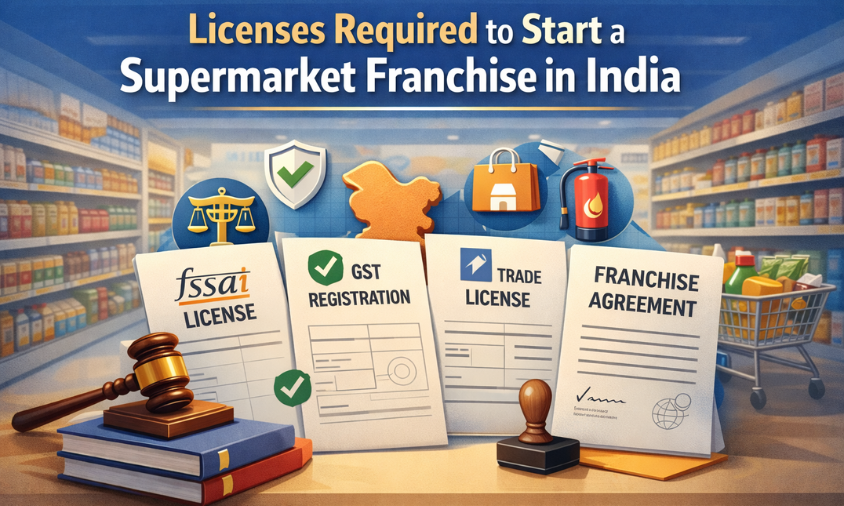
Opening a supermarket franchise in India can be considered an astute move, given that it is a growing phenomenon in Tier 2 and Tier 3 cities of India. But prior to opening your franchise, it is important to note the licenses and legal formalities required in such a business. The nature of your business covers various areas such as food safety regulation, taxation, employment laws, and consumer protection laws, and hence, multiple approvals are required from the government.
Table of Contents
ToggleNon-acquisition of proper licenses may lead to fines, delays in operations, or in some cases, closure. Conversely, acquiring proper legal documents allows one to focus on business expansion. From trade licenses to FSSAI licenses, GST registration, to franchise agreements, each document is essential in creating a legal environment for starting a supermarket franchise
This blog outlines what licenses and registrations are required to set up a supermarket store in India and what are the purposes of such licensing for establishing a stable business entity in the future.
Why Licenses Are Important for a Supermarket Franchise
A supermarket franchise deals with food items, customers, employees, and finances on a daily basis. Due to the nature of the responsibilities involved in running the business, the supermarket franchise has to operate in an environment that is closely monitored by several state bodies.
The licenses help ensure that the food sold to customers is healthy to eat, taxes are paid on time, employees are treated with dignity, and the business stays within commercial standards.
Legal approvals work as a safeguard for both the entrepreneur as well as the customer. For instance, having an FSSAI license is proof of compliance with food safety standards, while the GST registration allows the customer to see the invoice and billing matters. Registration of the shop and establishment protects the rights of the employees.
As far as branding is concerned, franchises also like partners who adhere to all legal requirements. Legal documents are an assurance to suppliers, banks, customers, and the government that they are doing genuine business. To cut it short, legal documents are an essential part of having a stable supermarket in India.
Also Read: How to Start a Supermarket Business in India:Step-by-Step Guide
Business Registration Requirements
Before a person can apply for operational licenses, he or she has to register the business. The process of business registration determines business ownership, responsibility, and taxation.
The different types of businesses that entrepreneurs can opt for are sole proprietorship, partnership, LP or LLP (Limited Liability Partnership), or private limited company. The implications of LP or LLP and a private limited company are that they both are to be registered at the Ministry of Corporate Affairs (MCA).
Key Business Registration Documents:
- Business Registration Certificate
- PAN (Permanent Account Number) for taxation
- TAN (Tax Deduction and Collection Account Number) for salary and vendor payments
- Current Bank Account in the Business Name
- GST Registration (mandatory if turnover exceeds ₹40 lakh or in case of inter-state sales)
They are the legal bases for the supermarket business franchise.
Also Read: The Cost to Open a Supermarket or Grocery Store in India
Trade License from the Local Municipality
Supermarket trade requires a trade license in order to be operational in the local area. This is a local government-issued license that certifies that the concerned store is operating as per the local laws concerning public safety, health, and trading.
In applying, a requirement is to submit proof of identity, proof of residential address, business information, and store layout. An applicant may apply online or at a municipal office.
The processing period will be between 7-15 working days, and charges could range between ₹5,000 and ₹20,000 a year.
FSSAI License (Food Safety Approval)
In case a grocery store deals in food articles, packaged foods, dairy products, and/or beverages, an FSSAI license is a must. FSSAI, which stands for Food Safety and Standards Authority of India, is the issuing authority of such licenses.
Types of FSSAI Licenses:
- Basic License – For Turnover of upto ₹12 lakh
- State License – If turnover is between ₹12 lakh and ₹20 crore
- Central License – In case of large chains or multi-state operations
The required documents are: premises address proof, store layout, list of food items, identity proof of the owner or directors, and NOC from the city. The time required for approval is 15-30 days.
Shop & Establishment Act Registration
Every retail business in India has to be registered under the Shop and Establishment Act. This deals with the working hours and wages of employees.
This registration serves as legal proof for the existence of the business and is usually asked for while opening a loan account, during audits, and so on. Every state in the country has its own Shop and Establishment Act. Hence, the regulations differ.
Also Read: A complete guide to the supermarket model
Fire & Safety Compliance
Fire and safety compliance is compulsory in supermarkets as they bear the load of high footfalls and electrical equipment usage. It’s issued after inspection by the local fire department.
The approval proves the existence of fire exits, extinguishers, alarms, and emergency systems. Proper fire compliance saves lives, reduces business disruption, and avoids legal action.
Franchise Agreement & Legal Review
A franchise agreement is a legal agreement between a franchisor and a franchisee. It is essentially a contract that maintains trademark, property, and process.
These are: franchise costs, royalty rates, territorial protection, training and assistance, reporting obligations, and terms of termination. Due diligence by a lawyer to check all clauses prevents any injustice and risk to the franchisee.
How SuperKirana Simplifies Licensing for Franchise Partners
SuperKirana provides structured and comprehensive support to franchise partners, enabling them to handle licensing and related legal processes smoothly when setting up a supermarket franchise in India. From FSSAI and GST registration to Shop & Establishment Act licensing and franchise documentation, SuperKirana’s team provides step-by-step assistance throughout the process.
Partners receive clear documentation checklists, application support, and expert coordination to ensure there are no delays or compliance errors. This allows entrepreneurs—especially first-time business owners and traditional kirana store operators—to focus on store setup, operations, and growth instead of paperwork.
With SuperKirana, managing legal compliance for a supermarket franchise in India becomes simple, transparent, and completely hassle-free.
Also Read: Documents Required to Start a Supermarket Franchise Business in India
Conclusion
Licenses and legal approvals form the backbone of a successful super market franchise business in India. Licenses and legal approvals will shield the business from any kind of penalties and will ensure consumer confidence in the business. Although the procedure appears complicated, planning and guidance will help overcome this hurdle.
Thus, by selecting a trusted franchise partner such as SuperKirana and adhering to the aforementioned legal requirements, entrepreneurs can start a compliant, profitable, and scalable business in setting up a supermarket in India.
Also Read: Top Supermarket Franchises in India